
Marshall County Multi-Day Arrest Log
Marshall County publishes no rolling 72-hour list or weekly police blotter. The closest official tool is the Sheriff's inmate roster. It offers tabs for Current, Released, and Archived Inmates, plus name and date searches, a show-all option, and adjustable sorting. For a multi-day arrest review, the Released tab matters most. Short jail stays drop off the current list quickly, yet the booking record stays reachable in another part of the interface.
The Sheriff also maintains a dated press-release feed with category and year filters. It is editorial, not comprehensive. Plenty of routine arrests never get a release. Treat the roster as the person-level source for Marshall County arrests, and press releases as context for a handful of cases.
Read Marshall County Arrest Records
Expect to build a date range from roster entries instead of finding one tidy blotter page. Each time an arrest result looks relevant, save the booking number. That number is the cleanest way to tell apart two custody events involving the same name when a follow-up request is needed.
- Open the roster and use the Date control or Newest-to-Oldest order to reach the first day in the period.
- Review Current Inmates for people still held at the Marshall County detention center.
- Switch to Released Inmates and sort by release time to catch short stays and bond-outs.
- Use Archived Inmates when the date is older than the released view or the live result is no longer easy to locate.
- Search Sheriff press releases by year for selected incident context, then confirm the final status through the court.
For the newest current booking only, the Marshall County 24 Hour Arrests page is the tighter fit. The log method here reaches further, spanning custody changes and older dates rather than a single day.
Marshall Arrest Log Fields
A roster profile holds what the detention center recorded at booking and release. A press release may layer an agency narrative on top, but it never replaces the profile itself or the case docket.
| Field | Meaning in a multi-day review |
|---|---|
| Name and age | Basic identifiers that should be checked against the full profile. |
| Booking number | The identifier for one jail admission or custody event. |
| Booking date and time | Places the event within the chosen period. |
| Charges | Charges recorded at booking, subject to later court action. |
| Bond | A stated release condition, not punishment or proof of guilt. |
| Release date and time | Shows when county custody ended or changed. |
| Photo | An official profile image where available; public display is not guaranteed for every entry. |
Agency, incident location, and narrative detail tend to live in a press release or news report rather than the roster. Keep those source types straight. A jail field reflects custody. A police narrative describes an investigation. A court disposition is the formal case result, and only the docket carries it.
Marshall Arrest News Is Selective
WAFF and WEIS run selected Marshall County arrest stories. Their reporting can name the investigating agency, explain why officers sought a person, or describe a move from a city jail to the county detention center. Coverage is spotty, though. Many arrests go unreported. Images in a news story might come from an agency or show evidence, a scene, or someone else entirely, so labeling them mugshots is a mistake.
This WAFF page is the regional news source behind selected Marshall County coverage.
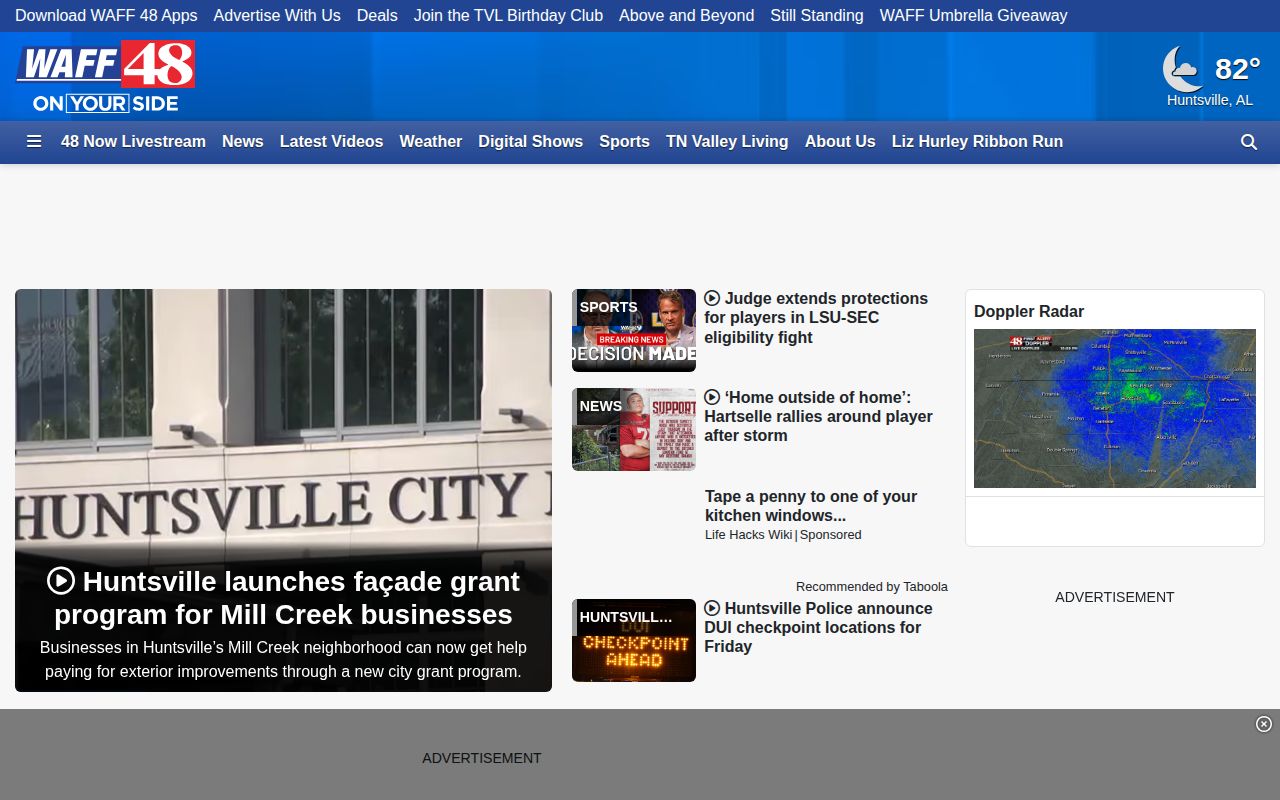
A news home page is a discovery route, nothing more.
WEIS Radio carries selected arrest reporting too. Its Albertville coverage documented one city-jail booking followed by a transfer to Marshall County Jail, which shows why agency and booking times can diverge. One case proves no transfer rule, though. Read news stories for context only after checking the Sheriff's roster and the right court record.
Marshall Sheriff Enforcement Releases
The Sheriff's press-release page posts dated items with Category and Year filters. Some cover public-assistance requests. Others announce arrests or enforcement operations. Each entry keeps the Sheriff's own wording and its original publication date, which helps when you want to trace how a Marshall County arrest unfolded. What the page does not do is list everyone booked into the jail, so treat it as announcements rather than a full arrest log.
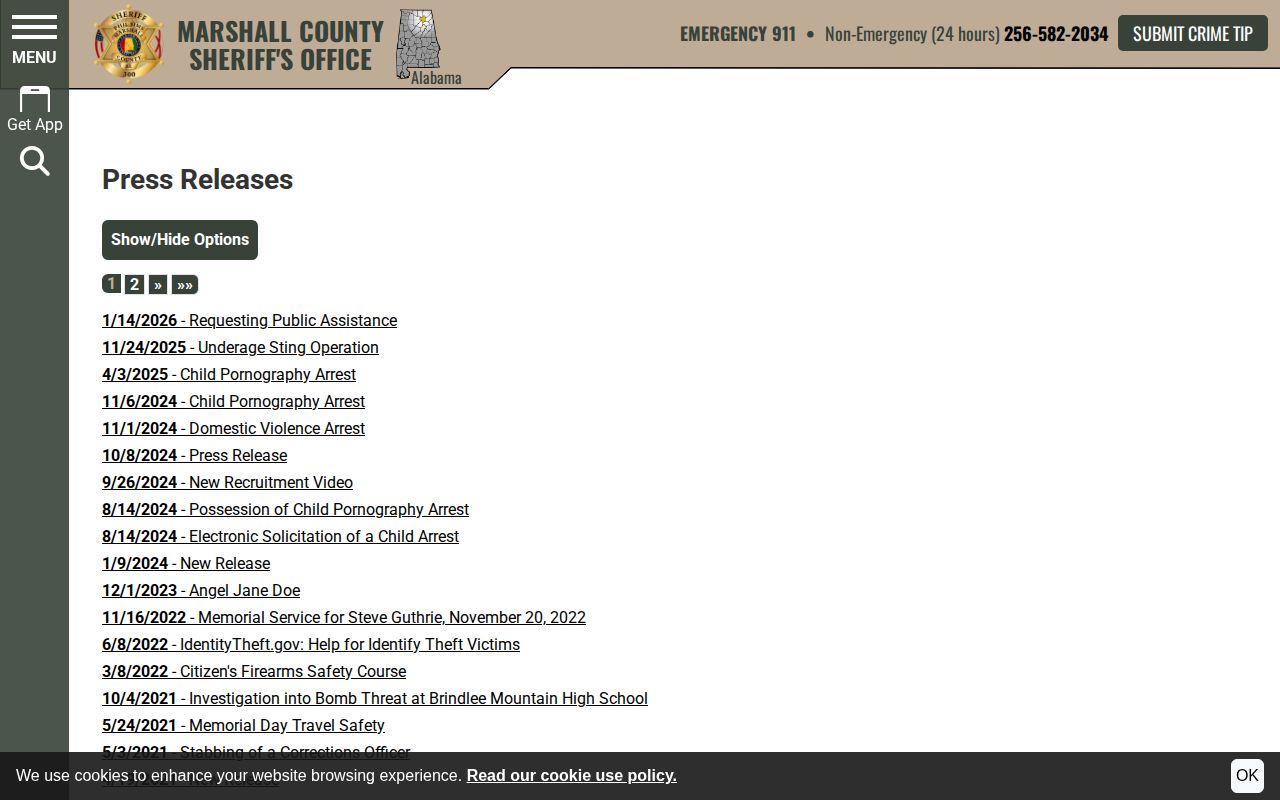
The category and year tools help find selected events without promising full roster coverage.
Read each release next to the roster profile. The release may explain the investigation, while the roster supplies booking details and custody status. Later court records show whether prosecutors changed the filed charge or how the case resolved.
Marshall Arrest Data Can Shift
Roster totals can shift for technical reasons. WAFF reported a May 2026 glitch that made more than 7,000 people appear released while only 11 showed as current. The Sheriff said no mass release happened and pointed people to the app. For a multi-day arrest review, that kind of fault distorts both ends of the window. You could miss someone in custody or read old entries as fresh releases.
When a count moves sharply, skip the total and compare individual booking and release times. Check the app, reload the roster, and call 256-582-2034 if a real discrepancy remains. A screenshot or news report preserves what appeared at one moment. Live confirmation still matters more.
Note: The Sheriff publishes no guaranteed update cadence, so a delayed entry should be described as unconfirmed rather than absent.
Boaz Arrest Counts Add Context
Boaz puts out monthly numbers in its city meeting packets. Think of them as a pulse check on police activity, not a roster. The packets counted 76 arrests in December 2025, 69 in January 2026, and 114 in October 2024. Nobody is named. The totals also say nothing about how many people actually landed in the Marshall County jail, since they track city activity across separate reporting periods.
Handle these figures with care. Multiplying one month into a yearly estimate will mislead you fast. Comparing a monthly arrest count against a current roster count misleads too, because the roster measures people in custody while the packet measures arrests made. The numbers stay useful only as a local trend signal, and only when the month, the agency, and the aggregate nature of the count stay glued to them.
Marshall Arrest Archives and Requests
How far back does the Sheriff's online archive reach? A May 2020 announcement described the feature as covering people released since January 1, 2020, plus an Archived Inmates range from February 28, 2008 through December 31, 2019. That statement reflects the online depth planned at launch. It is not a retention schedule, and it does not promise that every booking photo or profile is still viewable today. The Sheriff's announcement describes the roster archive feature in the office's own words, so treat it as a starting point for older Marshall County arrest research rather than a guarantee.
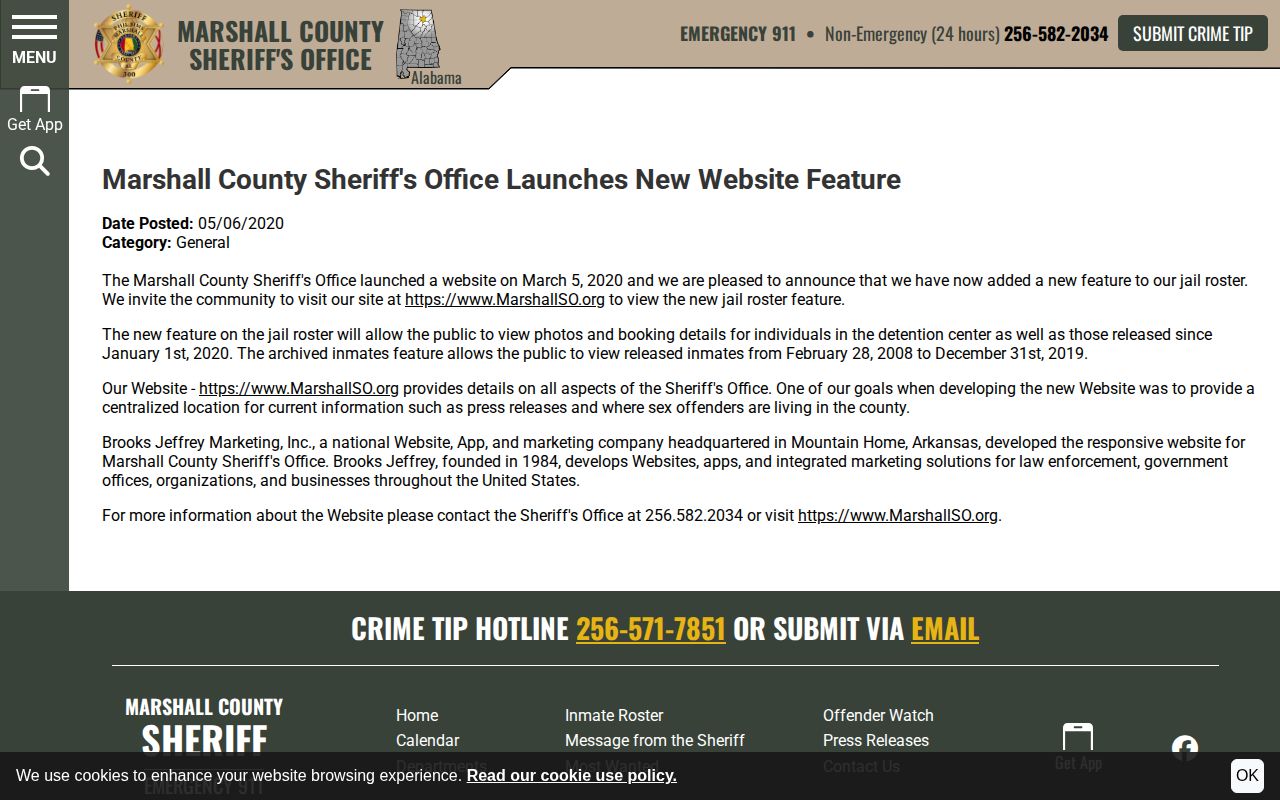
The archive helps with searching. It does not lock in how long booking photos are kept.
Suppose an older record does not surface in the interface. Write down the name, the approximate date, and the booking number if you have it. Then contact the Sheriff's Office at 423 Blount Ave, Guntersville, AL 35976, or call 256-582-2034 and ask for the records custodian. Say up front that the request covers a defined date range and a specific booking record. The county publishes no fee or response timeline, so ask about both before assuming anything.
For the final case outcome, go to the Marshall County Circuit Clerk or AlaCourt rather than relying on an old booking snapshot. Keep the online archive question and the record-retention question separate in your mind. Alabama Archives notes that local agencies follow approved retention and disposition schedules, yet no Marshall-specific public term for booking photos exists. Ask the Sheriff directly whether the exact record is still held, whether a copy can be certified, and whether any field must be withheld or redacted. A missing web profile does not mean the agency destroyed the record.
Past the Marshall Online Window
Alabama's local records schedules set the rules for how agencies retain and dispose of covered records, but the Sheriff's office publishes no Marshall-specific term for booking photographs. Online visibility is one thing. Agency retention is another. A profile can drop out of a convenient search view while the custodian still holds the record, and an agency may lawfully restrict part of a file that contains juvenile, victim-identifying, sealed, expunged, or active investigative material.
Chasing an old arrest entry? Work the tabs in order: Current, Released, then Archived. Record the booking number. Ask the Sheriff for the exact date range and whether the record or booking photo can be copied or certified. Then check the clerk for the court result. Alabama Archives serves as a historical lead only when material was transferred or microfilmed, and its county-records guidance notes that most physical local records stay with the office that created them. The archive does not hold current Marshall booking photographs.
The sequence guards against a common mistake. An old arrest log freezes a single moment, while a later court file may show an amended charge or a different result that changes what that snapshot meant. Preserve both dates and label each source by its role.
Public Record Search
Sponsored Results